How to Turn More Website Visitors Into Leads Without Increasing Ad Spend
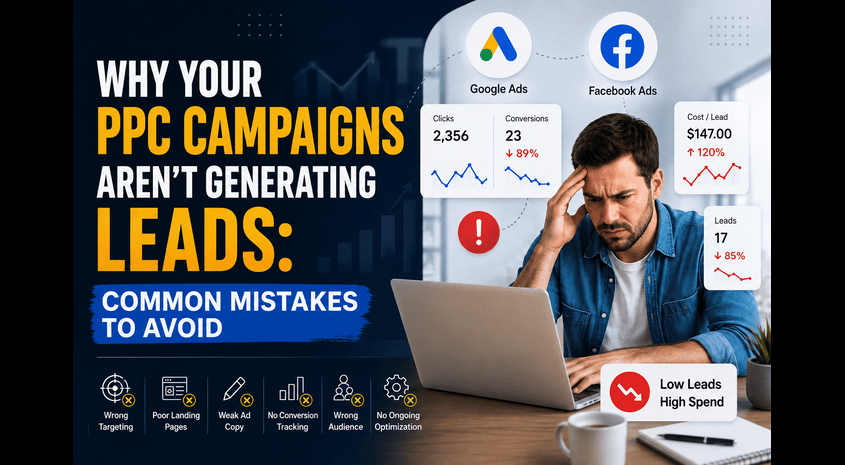
Gaining more traffic on your website seems to be the right solution to gain more leads. However, how would you react if your website is receiving more traffic while having low-quality leads at the same time? The majority of businesses try to tackle this challenge by increasing their advertising budgets. They invest more money in Google ads, social media, or any other advertising platforms with the idea that more traffic equals more customers. The fact is that more traffic will not solve the problem of low conversion rates, especially if your paid media strategy is bringing traffic that does not match your target audience.
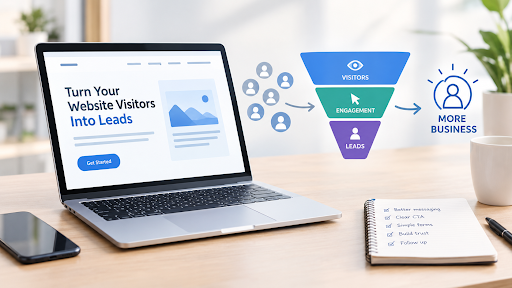
Since you are already receiving traffic on your website, there is another chance you have been ignoring up until now. There is no need to pay for more clicks and you should start thinking about maximizing the value of your current traffic. Having a proper offer, creating good landing pages, improving calls to action, using less complicated forms and effective follow-ups are the key aspects of turning website visitors into leads. AimLogic helps businesses focus on these areas to make better use of their existing website traffic.
Why Your Website Traffic Isn't Turning Into Enough Leads
Website traffic is just one step on the way to your future customer. A visitor becomes valuable when they take an action that moves them closer to becoming a customer. For instance, your site gets 10,000 visitors a month, but converts them into leads at 1%. You will get about 100 leads. However, if you increase the conversion rate up to 2%, then with the same traffic you will get 200 leads. There was no need to get additional 10,000 visitors; you just used them more effectively.
That is why web optimization for conversions might become one of the key steps in your lead generation strategy.
Find Where Visitors Are Losing Interest
Begin by observing what happens after the visitor lands on your website. Does the user leave immediately? Does the user visit many pages on your website but does not contact you? Does the user begin completing a form but then stops?
All these behaviors tell you where on your website you are losing opportunities for generating leads. Typical issues that may be discovered include: unclear message, poor call to actions, slow pages, complex forms, mobile experience issues, and no trust factors. It is much better to find these issues than to spend extra money on marketing.
7 Ways to Convert More Website Visitors Into Leads
If you are able to identify the areas where people are leaving your site, then you are ready to improve the aspects of your site that will affect conversion rates. You don’t have to rebuild your entire site; sometimes little changes will go a long way.
1. Make Your Value Proposition Clear
Your visitors need to be able to see what your business is all about and its importance in just a few seconds after arriving on your website. The most important headline needs to tell your visitors what you do for them or what is the problem that you solve. Don’t use vague headlines that mean nothing. Instead of using a headline like “Solutions for Your Business,” tell your visitors what your solution is and whom it is intended for. It will help to avoid confusion. In the supporting copy, you will tell your visitors all about your offer without any extra effort needed.
2. Give Visitors One Clear Next Step
A site may have high-quality content, yet produce minimal leads due to lack of understanding of what needs to be done next by the visitors. The CTA must tell the user what action he needs to perform next. It may vary from “Get a Free Quote”, “Book a Consultation”, “Request a Demo” or “Talk to an Expert”. Do not create several CTAs leading visitors in different directions. It’s much easier for the visitors to perform an action when all the pages have just one primary objective. It doesn’t mean you have to use the same button at any point.
3. Make Your Landing Pages Match Visitor Intent
The user who will click the ad related to a particular product or service must be redirected to the landing page where the user finds the information related to that particular product or service. Redirecting users to the home page will create problems for the users.
In case of natural search, the same rule is applicable. When the user is searching for something in particular, then he should be shown a page which fulfills his expectations. This relationship between the visitor and the landing page content will generate leads for your web page.
4. Make Your Forms Easier to Complete
The main problem might lie in the contact form itself, which may turn out to be the largest factor preventing the conversion. The form that is asking too many questions might seem tedious to complete. It is possible that for the initial contact all you need is just the person's name, email, phone, and message. In this case, there seems to be no point in asking for ten or fifteen fields of information.
Also, try to test your forms on mobile devices: fields should be easily clickable, and labels should be understandable, along with informing the person what will happen next.
5. Build Trust Before Asking for the Lead
When people are uncertain about whether a company will deliver what it promises, they are less inclined to reach out to the company. Trust factors can help with this issue. Include customer reviews, testimonials, case studies, certifications, awards, guarantees, or business experience when applicable.
Avoid placing all of your evidence on a dedicated testimonials page. Include trust factors near the key areas where you need conversions to occur. For instance, including a brief customer testimonial next to the contact form will provide visitors one more reason to fill out the form.
The aim is to help visitors get the answer to the question that might be preventing them from converting.
6. Capture Visitors Who Aren't Ready to Buy
Everyone might not be ready to ask for a quote or contact your sales team. Some might be evaluating options, researching, or trying to figure out their problems. If your only call-to-action is "Contact Us," then chances are that you might miss out on some customers. A valuable lead magnet would allow such people a better way to interact with your company. Depending on the kind of business that you run, it could be a list, guide, calculator, template, report, or even a free audit.
The resource needs to address an actual problem as opposed to serving merely as an attempt to get people's email addresses. In giving value to people, they have a solid reason to stick around and interact with your company. At the same time, do not ask for unnecessary information for accessing your resource.
7. Bring Visitors Back and Continue the Conversation
Some of the visitors may leave your website even if they are really interested in it. There may be cases where visitors will be distracted, require more time to think about their decision or just compare your company with other companies. In such instances, it is necessary for you to follow up. E-mail nurturing will help you keep in touch with those who are willing to communicate with you.
You can give them relevant information, respond to their questions, tell them some case studies and make appropriate offers. You may also use on-site methods of visitor re-engagement like exit intent messaging, chat invitation prompts and targeted offers so that visitors make some action before leaving the site. The important thing here is to ensure that the follow-up is useful to the visitors.
What Can Stop Your Website From Generating Leads?
Sometimes the problem is not that your website lacks traffic. The problem is that the website creates too many reasons for visitors to leave.
Too Much Information
More does not necessarily mean better. Too much content on a single page can make it hard for the visitor to find what he or she needs. Every important page should have just one function. Give your visitors what they need to know so that they will be able to take their next step.
Too Many Choices
A user who is given five different buttons to choose from, various forms, several deals, and many links could fail to make any choice at all. When making a website, provide your visitors with choices where appropriate, but ensure that your key conversion path is clear.
Consider your key pages and determine what action you would like the visitors to make, and ensure that this action is clear.
Poor Mobile Experience
The website might look good on a computer, but it might be hard to use on a mobile phone. You need to test your buttons, forms, menus, images, font size, and page spacing for mobile devices. The visitor should not be required to zoom in or find the correct button.
There are many visitors browsing the website using their mobile phones, hence making it harder for you to increase website conversions.
Slow or Broken Pages
However, a slow page will mean a waste of the money you have used to attract visitors. Test those pages that get paid traffic and ensure they are loading correctly. This involves compressing big images, eliminating any unneeded scripts and checking any elements slowing down the page.
It is also important to test all the forms and buttons on your website from time to time. An inefficient form will render an excellent landing page useless.
How to Measure Your Visitor-to-Lead Conversion
You cannot improve what you do not measure. Once you start making changes, track whether those changes actually improve your results.
Track the Right Metrics
Use your conversion rate, number of form fills, number of CTA clicks, calls, appointments, and qualified leads to begin your analysis. Analyzing only the number of visits is not enough to determine if your website is successful at converting visitors. You will also need to compare various landing pages. Some of them can have many visits but yield few leads, whereas others may have fewer visits and yield greater success.
Use Visitor Behavior to Find Problems
Website visitor tracking can help you understand what happens before a visitor converts or leaves. Through the use of analytics, you can know the pages the visitors visit, as well as where the conversion takes place. You can also use heat maps and session recordings to gain more insights about how users behave on the page.
For instance, if visitors are scrolling down the CTA button and not clicking on it, there is something that should be changed with respect to positioning and message of the call-to-action button.
Test One Change at a Time
There is no need to implement all ten tips simultaneously; choose just one to begin with, and evaluate its effectiveness. It can be done by running a test on a new headline, call-to-action button, form length, testimonial location, or promotion. After giving it sufficient time to get meaningful results, determine whether the change is worth keeping.
Small tweaks can lead to great results. Improvements in your CTA and form along with more trust-building elements will enable you to convert more leads online.
A Simple Website Conversion Checklist
Before increasing your advertising budget, review your website and ask:
- Is the main offer clear within a few seconds?
- Does each important page have a clear purpose?
- Is the main CTA easy to find?
- Does the landing page match visitor intent?
- Is the contact form simple?
- Does the website work properly on mobile?
- Are reviews and trust signals visible?
- Is there an option for visitors who are not ready to buy?
- Are you using website visitor tracking to understand visitor behavior?
- Are you regularly testing ways to reduce wasted ad spend and improve conversions?
You do not need to fix everything at once. Start with the page that receives the most relevant traffic and has the biggest conversion opportunity.
How AimLogic Helps Convert Website Visitors to Leads
AimLogic helps businesses in maximizing their current web traffic through understanding behavior and actions, identifying conversion points, and generating more leads. When businesses learn how visitors behave and interact with the website, they can understand where the visitors fall off during the process of becoming leads and improve upon those aspects of the website, such as landing pages and calls-to-action.
Conclusion
Generating more visits to the site does not necessarily mean that it will help to generate more leads. Increasing the advertising budget will only result in sending more potential customers into a conversion process which does not work.
It is important to focus on what happens after the visitor reaches the site. One should make his offer clearer, create specific landing pages, apply effective CTAs, make the forms less complex, create trust elements, and offer a convenient way for the interested visitors to connect.
After ths, one should analyze the results using data and keep on testing. Website lead generation is not only about attracting more visitors. It is also about helping the right visitors move forward.
Before investing money into new advertising campaigns, it is necessary to ensure that one’s website utilizes the visitors which he already has. Usually, the possibility of generating more leads lies within the existing website traffic. AimLogic can support this approach by helping businesses focus on turning existing website traffic into more valuable leads.


.webp)