
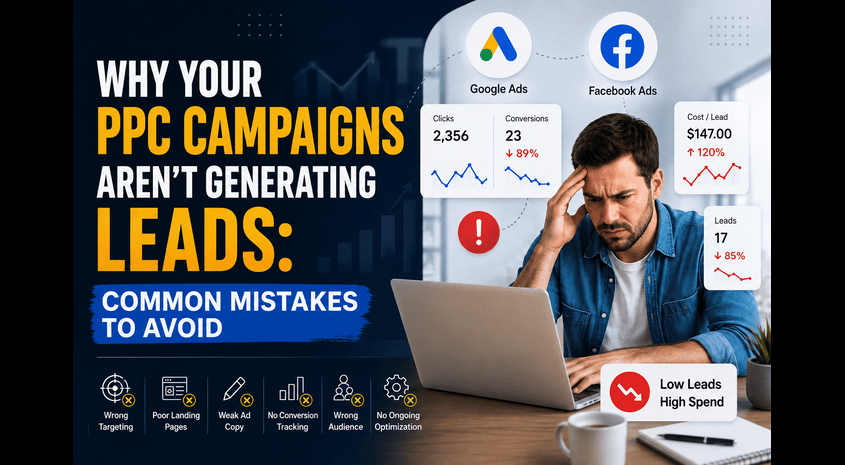
Why Your PPC Campaigns Aren't Generating Leads: Mistakes to Avoid
You have invested money into PPC, your ads are clicked but you still do not receive any leads. This is one of the most frequent problems our clients face at AimLogic. A successful PPC campaign may attract a huge amount of traffic to your website, but if the wrong audience sees your ads or your campaign does not target conversions, all your money will be wasted.
PPC and performance marketing campaigns are handled by AimLogic on the basis of one principle: the transformation of paid traffic into leads and paying customers. This is achieved through data, targeting, conversion monitoring, landing pages testing, and further optimization for minimizing costs spent on ads and improving performance of campaigns. PPC strategy involves Google Ads, Microsoft Advertising, remarketing, display, and other paid media.
The issue could be caused by any of these seven common mistakes if your PPC campaign isn’t getting enough leads.
1. Focusing on the Wrong Keywords
Selecting certain keywords purely based on their high search volume is another major PPC mistake that most business owners make. It is possible to have keywords that generate lots of traffic and not many clients. For instance, someone who types "what is PPC" into the search engine may be doing research, whereas someone typing "PPC management services in Denver" might be interested in finding a suitable provider.
That is why we are paying attention to search intent and whether the intent aligns with the service we are promoting. In addition to that, we analyze search queries to eliminate irrelevant searches and apply negative keywords where necessary. This allows us to avoid clicks that will never turn into leads.
As an expert PPC management company, AimLogic creates PPC campaigns from high-intent keywords and constantly analyzes campaign data to achieve better targeting and cut unnecessary costs.
2. Delivering PPC Visitors to the Wrong Page
Clicking the ad is just the beginning. We regularly encounter situations where every single PPC visitor is delivered to the homepage of the business. The homepage may include information about a variety of products, services, locations, and even some information about the company. All this information can overwhelm the visitor and confuse him on what he needs to do further.
The landing page should correspond to the ad. In case of an ad promoting Chicago PPC management services, the landing page should give all the necessary information about the service right away. In case of an ad for a particular product, the visitor needs to be led to its page.
- A good landing page should include:
- A clear headline;
- Matching messaging;
- A simple explanation of the offer;
- Trust signals/proof;
- Call-to-action;
- Easy way to contact;
- Mobile optimization.
At AimLogic, we dig deeper than just the ad itself. Landing pages, conversion tracking, and customer journey optimization are the crucial elements of our PPC approach because a great click has very little value if there is no conversion process.
3. Ads Which Get You Clicks Without Getting You Leads
There is nothing wrong with achieving high CTR, especially in PPC reports. The problem here is that clicks don't mean anything if you don't have any leads generated by those clicks. There are ads which are just meant to grab attention without saying much about the company or its services.
The offer should be obvious from the start, before anyone will click on it. Instead of using something like "Grow Your Business Online" in your PPC advertisement, you need to provide details about your offer and who it is addressed to.
We test different headlines, descriptions, offers, and calls-to-action to achieve results. Our aim here is not to get as many clicks as possible but to get more relevant clicks. At AimLogic, our PPC specialists are constantly testing and improving our campaigns.
4. Failing to Track the Right Conversions
If you cannot track which activities are delivering leads, you will not know if your PPC campaign is effective. There are some businesses that just track clicks and website visits. It tells you that people are coming to your site, but does not tell you if these people become your prospects.
Some of the conversions that your business should track depending on your nature of work are:
- Contact form submissions
- Phone calls
- Quotation requests
- Consultation bookings
- Purchases
- Demo request
- Subscriptions
We should be aware of which keywords, ads, audiences and campaigns are driving these conversions. Without knowing this information, the PPC decisions can turn into guesswork. You might end up spending more money on a campaign that delivers a lot of clicks but reducing a campaign with less clicks but better conversions.
AimLogic uses conversion tracking, analytics and revenue attribution to find out which activities are really helping your business grow.
5. Evaluation Based on Number of Clicks vs Lead Qualities
Just because there’s a higher volume of traffic doesn’t mean that there will be a lot of business. For example, one campaign gets 500 clicks and five leads, whereas another gets 200 clicks but 15 qualified leads. In this case, the latter is much more valuable despite having less traffic.
The essential indicators for lead generation could be:
- Conversion rate
- Cost per lead
- Cost per qualified lead
- Customer acquisition cost
- ROI (return on ad spend)
- Revenue
Lead qualities are also important. When your sales department starts receiving a high number of requests from people who are not your target audience, you know that something needs to be changed about the campaign’s targeting.
6. Not Considering Competitors and Website Visitors' Targets
Search advertising works great but it is not the only way to reach prospective customers. A person visiting your website is showing an interest at least a little bit. And when a person visits a site of your competitors, he might be looking for a similar product or service you are selling.
That is how the Website URL Targeting technology provided by AimLogic could help you. We have unique Website URL Targeting technology which enables companies to target the web traffic associated with chosen website URLs including those of your competitors and other related companies in the industry. Our idea is to present your brand to the audiences interested in your market. AimLogic claims this technology is one of the patented methods.
It does not mean we implement this method in all PPC campaigns. It should be relevant for your audience, industry and campaign goals. But when it is appropriate, it could provide you with another option to address high-intent customers beyond keyword targeting.
Performance marketing approach used by AimLogic aims at delivering business results such as leads, acquisition cost, revenue and ROAS instead of vanity metrics only.
7. Starting the Campaign and Letting Go
PPC does not mean setting up a campaign and leaving it as it is. What worked well in a certain campaign right now may not necessarily work the same way in the coming months. Why? Changes happen in search behavior, competitors bid differently, there are new search phrases, and ads no longer work as effectively as before.
The following actions are just some of the changes that we do in campaigns:
- Delete underperforming keywords
- Add negative keywords
- Test different ad copy
- Adjust bidding
- Check the performance of the audience segments
- Improve landing pages
- Check conversion numbers
- Shift the budget to more performing campaigns
In AimLogic, the process is very straightforward: start the campaign, test it, optimize it, and repeat.
Why Should Your Business Consider Using AimLogic PPC Management Services?
We believe that PPC management is not only about creating ads and monitoring clicks but about the whole funnel starting from targeting to traffic and conversions. The following types of paid campaigns are available: paid search, Google Shopping, Performance Max, Local Services Ads, Microsoft Advertising, YouTube Ads, display advertising, programmatic advertising, and remarketing. It all depends on the business, audience, and objectives.
What makes us unique and why should you consider using our services:
1. Data-Based Campaign Management: All decisions are based on campaign and conversion data analysis. We assess what works, what needs optimization, and what consumes budget without providing any value.
2. End-to-end Approach: Not every customer will convert on the first try. We can use the combination of search, display, remarketing, audience segmentation, and other paid channels to reach customers at various stages of their purchase process.
3. Proprietary Technologies: Our technologies have the capabilities to offer advanced audience targeting and insights that will enhance your campaign management. For example, our Website URL Targeting technology was created specifically for the purpose of reaching people engaging with competitor and industry websites. AimLogic currently holds 3+ patents in its technology portfolio.
4. Ongoing Campaign Optimization: We do not just launch a campaign and forget about it. We are constantly testing, reviewing, and adjusting our campaigns based on actual results.
5. Focused on Business Outcomes: Instead of maximizing clicks and impressions, we strive to deliver high-quality leads at lower costs, higher conversion rates, and positive ROI from advertising.
What Should You Do If Your PPC Campaign Does Not Generate Leads?
Don’t increase the budget without analyzing your PPC campaign first.
Do you:
- Have the right audience targeted?
- Use keyword phrases that have high buying intent?
- Have matching landing page and ad?
- Really measure conversions?
- Measure quality leads rather than clicks?
- Test and optimize the campaign?
If you’re answering “no” on many of these questions, increasing the budget will only increase your waste. Instead, start by finding out where the problem lies, optimize the structure of the campaign, and then increase its size.
Conclusion
Indeed, a PPC campaign can deliver leads; however, just placing an advertisement will not suffice. There should be effective keywords and ad copy, a good landing page, correct tracking, good targeting, and proper optimization for that. At AimLogic, we take a performance-oriented approach when managing our PPC campaigns. By using data, we determine what works well and what does not, and allocate ad budgets in such a way that these opportunities may result in growth.
If you have a PPC campaign delivering clicks, but few leads, the solution may not necessarily lie in increased budgets.


.webp)